The recent upward trend in the S&P 500 index is largely attributable to the performance of companies involved in artificial intelligence. This suggests that the current market upswing is less about a widespread economic recovery and more about a concentrated growth in a specific sector. Data indicates that without the contributions from AI-focused enterprises, the broader index's gains would be minimal, if not negative, contrasting sharply with the substantial growth seen in AI-related equities. This thematic leadership echoes historical periods where a single transformative technology dominated market movements, prompting discussions about the sustainability and implications of such concentrated growth.
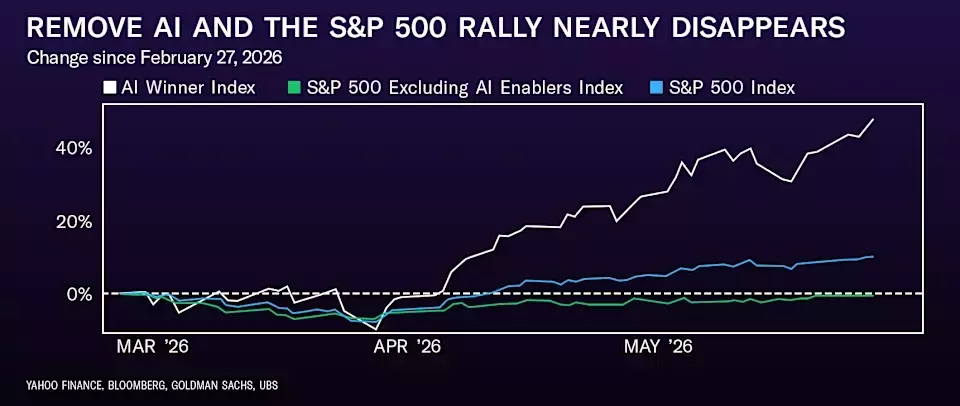
A recent analysis highlights the striking disparity within the S&P 500's performance. Since late February, while the overall S&P 500 has climbed approximately 10%, an index specifically tracking AI innovators has soared by over 45%. In stark contrast, a version of the S&P 500 that excludes these AI-enabling companies shows a slight decline over the same period. This illustrates that the narrative of a robust "bull market" might be misleading, as the momentum is heavily skewed towards a select group of AI-driven firms. This pattern of concentration is not entirely new, having been observed in 2023 with the "Magnificent Seven" tech giants—Apple, Alphabet, Microsoft, Amazon, Meta, Tesla, and Nvidia—driving the market while other sectors lagged. However, the current situation is even more thematic, extending beyond just a few large corporations to encompass AI infrastructure, software, and related industries that are direct beneficiaries of the AI spending boom.
Market observers, such as Jim Bianco of Bianco Research, contend that the current level of market concentration around a single theme is unprecedented in the last 150 years. Bianco draws a historical parallel to the railroad expansion of the late 19th century, a period when railroad companies dominated capital markets due to their profound impact on the economy. He argues that AI possesses a similar transformative potential. Bianco Research's data further supports this, revealing that a group of 41 identified AI-related stocks now account for nearly half of the S&P 500's total market capitalization. This raises concerns about concentration risk, leading to debates on whether the market is experiencing a bubble. While the risk is acknowledged, pinpointing the exact phase of a potential bubble cycle remains challenging. Past examples, like the dot-com bubble of the late 1990s, show that early warnings of "irrational exuberance" did not prevent substantial further rallies before the eventual downturn.
Ultimately, the S&P 500's trajectory hinges significantly on the sustained leadership of the artificial intelligence sector. As long as AI continues to drive innovation and attract investment, the market's upward momentum may persist. However, should the growth in AI-enabling companies falter, the broader index might find itself with considerably less underlying support than its headline figures currently suggest, potentially leading to a re-evaluation of market stability and investor strategies.