Unlocking Superior Returns: Dividend ETFs vs. The Market
The Allure of Dividend Investments in a Growth-Driven Market
Historically, dividend-paying stocks have often been recognized for their stability and consistent income generation rather than aggressive growth. In recent times, however, the investment landscape has been heavily influenced by the exceptional performance of growth-oriented companies, particularly those in the technology and artificial intelligence sectors. This phenomenon has led many to overlook the steady returns offered by dividend stocks.
Unexpected Market Leadership: Dividend ETFs Surpass S&P 500
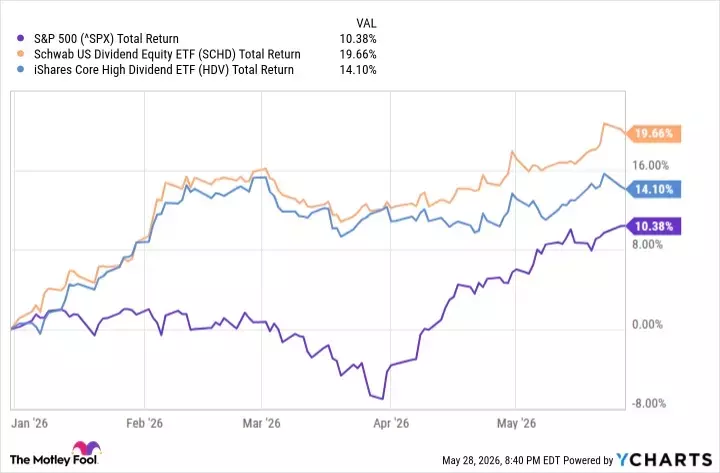
Defying conventional expectations, two significant dividend-focused ETFs have demonstrated remarkable performance, outpacing the broader S&P 500 index so far in 2026. The Schwab U.S. Dividend Equity ETF (SCHD) has delivered an impressive 19.7% total return, while the iShares Core High Dividend ETF (HDV) recorded a solid 14.1% return. This unexpected success underscores the potential of dividend strategies even in markets dominated by growth narratives.
iShares Core High Dividend ETF: A Deep Dive into Diversified Income
The iShares Core High Dividend ETF (HDV) is engineered to mirror the performance of a Morningstar index comprising high-yield dividend stocks. This fund boasts a low expense ratio of merely 0.08% and, as of late May, includes 74 distinct holdings. It has provided investors with a trailing 12-month dividend yield of 2.9%, making it an attractive option for income-focused investors.
Sector Allocation and Top Holdings of HDV: A Counter-Cyclical Approach
HDV's portfolio displays a clear preference for sectors traditionally known for stability and consistent cash flow, with a significant allocation to consumer staples (24.5%), energy (20.8%), healthcare (16.9%), financials (10.7%), and utilities (9%). Notably, information technology constitutes a smaller portion of the fund, only 8.7%. Its primary holdings include energy giants ExxonMobil and Chevron, healthcare leaders Johnson & Johnson and AbbVie, and consumer staple powerhouse Philip Morris, with Texas Instruments being the sole technology representative in its top ten holdings. Over the past three and five years, HDV has posted annualized returns of 14% and 11.4%, respectively, though it has trailed the S&P 500 during these longer periods.
Schwab U.S. Dividend Equity ETF: Broader Exposure with a Tech Twist
The Schwab U.S. Dividend Equity ETF (SCHD) offers a broader exposure to 103 stocks that are part of the Dow Jones U.S. Dividend 100 Index. This fund has generated a trailing dividend yield of 3.3%. SCHD's sector distribution is somewhat similar to HDV's but with a slightly higher emphasis on technology. Its top sectors include consumer staples (19.4%), healthcare (18.8%), energy (16.9%), industrials (11.5%), and information technology (11.1%).
SCHD's Key Constituents: Blending Income with Tech Exposure
SCHD's top holdings reveal a blend of income and technology, with AI-related companies Qualcomm (approximately 6.3%) and Texas Instruments (approximately 6.1%) collectively accounting for 12.4% of the fund's assets. Other significant holdings feature UnitedHealth Group, Coca-Cola, and Merck. SCHD's annualized returns over the last three and five years stood at 14% and 9.1%, respectively, also underperforming the S&P 500 over these extended durations.
Strategic Choice: HDV for AI Diversification
For investors aiming to reduce their exposure to the potentially volatile tech and AI sectors while still benefiting from dividend income, the iShares Core High Dividend ETF (HDV) presents a compelling option. Its lower allocation to technology stocks, particularly AI-focused companies, provides a buffer against potential downturns in that segment of the market. While both ETFs offer attractive features and low expense ratios, HDV's more diversified approach away from concentrated tech holdings makes it a preferable choice for a specific investment strategy focused on income and stability.