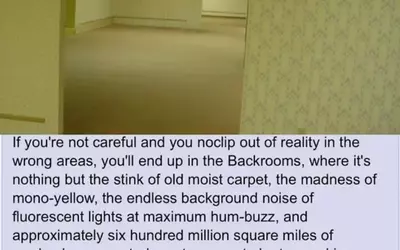
A24's latest horror film, "Backrooms," has captivated viewers, leaving many to ponder the cryptic nature of its conclusion. Director Kane Parsons, while hesitant to offer a definitive explanation, provides tantalizing clues into the film's profound symbolism, particularly regarding the protagonist, Clark, and the enigmatic dimension he inhabits. This report summarizes the key events of the movie's ending and Parsons' interpretation, shedding light on the psychological and philosophical themes woven into its narrative.
Dissecting the Climax: Clark's Fate and the Backrooms' Enigma
In the haunting narrative of "Backrooms," Clark, a struggling architect and furniture store owner portrayed by Chiwetel Ejiofor, stumbles upon an otherworldly, liminal space. This dimension, a labyrinth of distorted rooms and familiar yet unsettling environments, becomes a terrifying mirror to his own psyche. Within this space, he encounters a malevolent entity, an elongated, grotesque version of himself, dubbed "Pirate Clark," dressed in a costume reminiscent of his store's advertisements. This creature, Parsons explains, is a "misremembered" manifestation of Clark by the Backrooms, reflecting his inner world and destructive tendencies. The film culminates in a pivotal scene where Clark, seemingly at peace with his doppelgänger and the Backrooms' chaotic embrace, hugs Pirate Clark, only to be brutally killed by it. Mary, Clark's therapist (Renate Reinsve), who ventured into this alternate reality to find him, witnesses this horrific event. She manages to escape back to the real world, where Pirate Clark is eventually apprehended by an organization investigating the Backrooms.
Parsons emphasizes that Pirate Clark's fatal attack on Clark serves as the narrative's emotional and thematic core. He views the Backrooms as an "echo chamber" of Clark's internal struggles, a feedback loop where his desires and unresolved issues are externalized. The director suggests that Clark's perceived peace within this space is a delusion, a twisted form of solace born from an atomized life. Pirate Clark is not merely a static reflection but an active, evolving representation of Clark's being, constantly mirroring aspects of his original self. This dynamic relationship between Clark and his monstrous counterpart underscores the film's exploration of self-delusion, psychological projection, and the blurred lines between reality and perception. While Parsons jokingly posits that Pirate Clark's actions could be attributed to hunger, he affirms its deeper symbolic resonance within the narrative.
Reflections on Self, Reality, and the Unseen
"Backrooms" masterfully crafts a narrative that invites introspection into the nature of self-perception and the fragility of reality. The film prompts us to consider how our internal landscapes can manifest externally, and how readily we might succumb to comforting delusions in the face of profound personal failings. Clark's journey into the Backrooms serves as a chilling allegory for confronting one's inner demons, suggesting that true healing comes not from embracing self-destructive tendencies, but from acknowledging and overcoming them. The enigmatic nature of the Backrooms itself, a space that molds itself to the inhabitant's psyche, highlights the subjective experience of reality. This cinematic experience leaves us contemplating the unseen forces, both internal and external, that shape our existence and the terrifying consequences of losing touch with objective truth. It's a stark reminder that sometimes, the monsters we encounter are merely reflections of the ones we carry within.