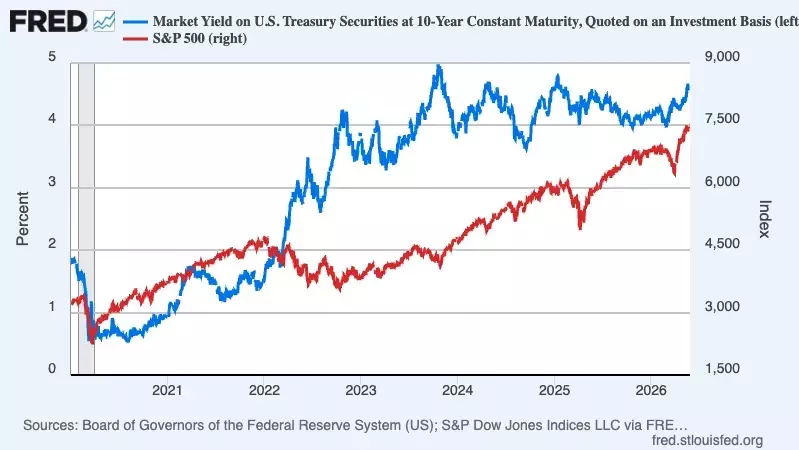
Conventional wisdom often suggests that an increase in interest rates should directly lead to a decrease in stock market valuations. However, market realities are far more intricate than this simplistic inverse relationship. This report delves into why such a direct correlation often fails to materialize, arguing that various interconnected factors, most notably robust earnings growth, play a crucial role in maintaining and even enhancing equity valuations despite upward movements in interest rates. It emphasizes the need for a comprehensive analytical approach rather than relying on isolated metrics to predict market behavior.
The Nuances of Interest Rates and Equity Valuations
In a recent analysis by DataTrek Research, co-founder Nick Colas challenged the widely held notion that rising long-term interest rates inevitably depress stock market valuations. His findings, shared on Wednesday, May 31, 2026, illuminate the complex interplay between macroeconomic indicators and equity performance. Colas pointed out that while the theoretical framework of discounted cash flows suggests that higher interest rates reduce the present value of future earnings, real-world market behavior often deviates from this simple model. For instance, between 2015 and 2019, the 10-year U.S. Treasury note averaged a yield of 2.27%, with the S&P 500's forward price-to-earnings (P/E) ratio fluctuating between 15x and 18x. Strikingly, as of the report's date, the 10-year yield had risen significantly to 4.49%, yet the forward P/E ratio also saw a substantial increase, reaching 21x earnings. This historical data directly contradicts the expectation that higher rates would lead to lower P/E ratios, demonstrating that other factors are at play. Colas's key insight is that if earnings growth expectations outpace the increase in interest rates, equity valuations can actually expand. This critical observation underscores a common pitfall among some market analysts: the tendency to isolate one variable in a complex economic model while assuming all others remain constant, a scenario rarely found in dynamic financial markets.
This analysis serves as a powerful reminder for investors and financial commentators to resist drawing hasty conclusions based on singular economic indicators. The financial markets are dynamic ecosystems where countless variables interact, often in non-obvious ways. A holistic perspective, incorporating factors like corporate earnings, technological advancements, and shifting investor sentiment, is essential for a more accurate understanding of market movements. Focusing solely on interest rate fluctuations without accounting for other significant drivers, such as strong corporate profitability and future growth prospects, can lead to misjudgments. The market's resilience in the face of rising rates is not a sign of irrationality but rather a testament to the complex web of influences that shape asset prices. Therefore, a deeper, multi-faceted analytical approach is crucial for navigating the intricacies of today's investment landscape.