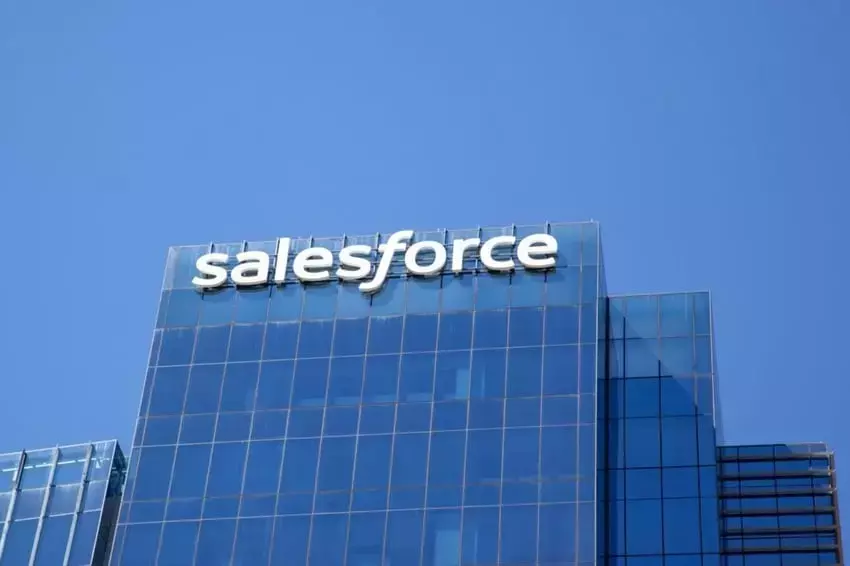
Despite a downturn in its stock performance, Salesforce's recent fiscal first-quarter earnings call saw CEO Marc Benioff confidently addressing market apprehensions regarding a 'SaaSpocalypse'. The company not only exceeded financial predictions for Q1 fiscal 2027 but also unveiled an impressive increase in premium AI transactions, signaling a robust strategic realignment towards autonomous AI. While certain traditional business areas experienced some softness, the company's aggressive share buyback initiative highlights its commitment to shareholder value and belief in a strong rebound in the latter half of the fiscal year.
Salesforce, a leader in cloud-based software, has been under scrutiny as the broader software-as-a-service (SaaS) sector grapples with market volatility. However, Benioff challenged the prevailing negative sentiment, emphasizing the transformative power of AI applications. He showcased Salesforce’s substantial investment and shift into autonomous AI as a core pillar of its enduring stability. This strategic move is intended to counter market skepticism and demonstrate the company’s forward-looking vision.
While the company's commitment to AI is clear, some analysts, like Patrick Moorhead from Moor Insights Strategy, point out that Agentforce, Salesforce’s AI initiative, currently contributes less than 5% to overall sales. This relatively small percentage, despite an impressive 205% annual recurring revenue growth to $1.2 billion for Agentforce, may explain why investors remain cautious.
Adding to the complexity, the impressive growth in next-generation technology bookings, specifically for Salesforce’s premium SKUs within its new autonomous “Agentforce” capabilities, expanded by nearly 60% year-over-year. Agentforce's annualized recurring revenue (ARR) also successfully surpassed the $1 billion mark during the quarter, indicating significant adoption and potential.
Financially, Salesforce reported an adjusted EPS of $3.88 against an estimated $3.12, with record revenues reaching $11.13 billion. To bolster its stock and enhance shareholder returns, the company executed its largest-ever $25 billion accelerated share repurchase program, resulting in a 10% year-over-year reduction in diluted shares. Management is confident that these operational strengths and a burgeoning AI pipeline will drive substantial organic revenue growth in the second half of fiscal 2027.
The primary factor contributing to Salesforce's conservative short-term revenue forecast was a temporary slowdown in its legacy divisions. Chief Operating and Financial Officer Robin Washington highlighted that the quarterly results were "partially counterbalanced by a slump in Commerce Cloud and Tableau," indicating that while new AI ventures are thriving, older segments require further attention.
Despite its internal growth and strategic AI shift, Salesforce’s stock (CRM) has underperformed the S&P 500, declining by 32.99% year-to-date compared to the S&P 500's 9.65% advance. The stock experienced a 1.89% drop in overnight trading and has seen significant declines over the past month, six months, and year. Benzinga’s Edge Stock Rankings suggest a weak long-term price trend for CRM, although it shows stronger trends in the medium and short terms.
Salesforce is navigating a transitional period marked by strong AI adoption countered by weaknesses in legacy sectors and overall stock depreciation. While management remains steadfast in its AI-driven future, investor confidence will hinge on the company’s ability to translate its AI successes into broader revenue acceleration and sustained stock appreciation in the coming quarters.