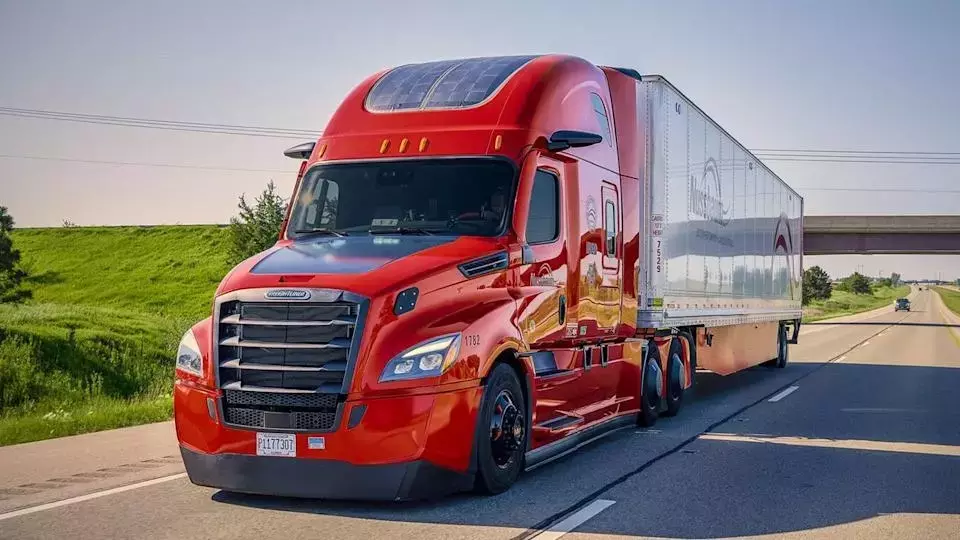
Nussbaum Transportation, an Illinois-based carrier, has recently unveiled a substantial compensation hike for its truck drivers, coupled with an innovative profit-sharing initiative. This announcement positions Nussbaum at the forefront of a growing industry trend where trucking companies are discreetly enhancing driver remuneration. The move by Nussbaum is anticipated to inspire other carriers to follow suit, as the sector grapples with recruitment difficulties and strives to retain skilled drivers in a competitive labor market.
Joseph Anderson, Nussbaum's recruiting director, confirmed that the latest pay adjustments represent the second increase within two months, though the prior one in April was not publicized. Anderson acknowledges that other carriers are also implementing similar changes, with one peer company having already increased driver pay levels. However, Nussbaum is notable for its transparency in communicating these changes to the public. According to Anderson, the company believes it is setting a precedent within the industry by openly discussing its enhanced compensation packages.
Leah Shaver, president of the National Transportation Institute, a prominent organization that monitors driver compensation, corroborates the trend of increasing pay. Shaver noted a conservative number of reported pay increases from fleets over the past month, primarily focusing on base pay and facilitating transitions for over-the-road drivers. These increases align with the rising complaints from fleets regarding hiring challenges in the first and second quarters, indicating a strong correlation between recruitment difficulties and compensation adjustments. Nussbaum, founded in 1945, has historically maintained a driver base of approximately 540 to 550 individuals. The company's flatbed operations have expanded significantly, from 11 drivers a year ago to about 50, reflecting an overall growth trajectory. With a substantial orientation group expected next week, Nussbaum aims to surpass the 550-driver mark, a record high for the company. Approximately 30% of Nussbaum's business is dedicated to specific clients.
The current adjustments mark a rapid shift in Nussbaum's compensation strategy. As recently as December 2024, the company had reduced pay for new hires and cut supplemental pay for 'key locations' such as Chicago-Kenosha/Racine, the Quad Cities, Indianapolis, and Columbus. These reductions were initially implemented after the post-pandemic freight surge, a period when major players like Schneider National also initiated pay increases. However, parts of these reductions were reversed in April 2026, and the latest policies further amplify driver earnings. Existing over-the-road drivers will receive an additional 3 cents per mile and a $50 increase in their weekly minimum guarantee. New drivers will see a starting pay increase of 5 cents per mile and a $100 boost to their weekly minimum. Additionally, the enhanced pay package for 'key locations' has been reinstated. Drivers in these areas, particularly those hired after the April and May increases, will benefit from a base rate that is 10 cents per mile higher than before the policy change. Furthermore, a sign-on bonus of $3,000 is offered for drivers transitioning from other employers, payable over six months and valid until the end of June. Flatbed drivers receive an even more attractive $5,000 bonus under similar terms. Nussbaum has also enhanced its 'early exit option,' increasing the payout from $1,000 to $2,000 for drivers who decide the company isn't the right fit.
The introduction of a profit-sharing plan is a landmark development for Nussbaum, marking its first such initiative for drivers. While not a fixed sum, this plan is projected to average 2 cents per mile annually, potentially reaching 4 cents per mile in strong years. This move aligns with broader market observations, as driver turnover has slowed, making it harder for companies to attract skilled drivers. Shaver's recent analysis highlights that drivers are less inclined to switch companies, not due to declining pay, but because their current roles offer comparable compensation. Despite a weak freight market in 2025, driver pay remained stable, a trend that continued into 2026. John Diez, CEO of Ryder, noted that the improving freight market is expected to drive higher driver pay levels, with increased turnover and activity already observed in Q1. He predicts a rise in sign-on bonuses in select markets, followed by broader wage inflation, signaling a dynamic shift in the industry's compensation landscape.